

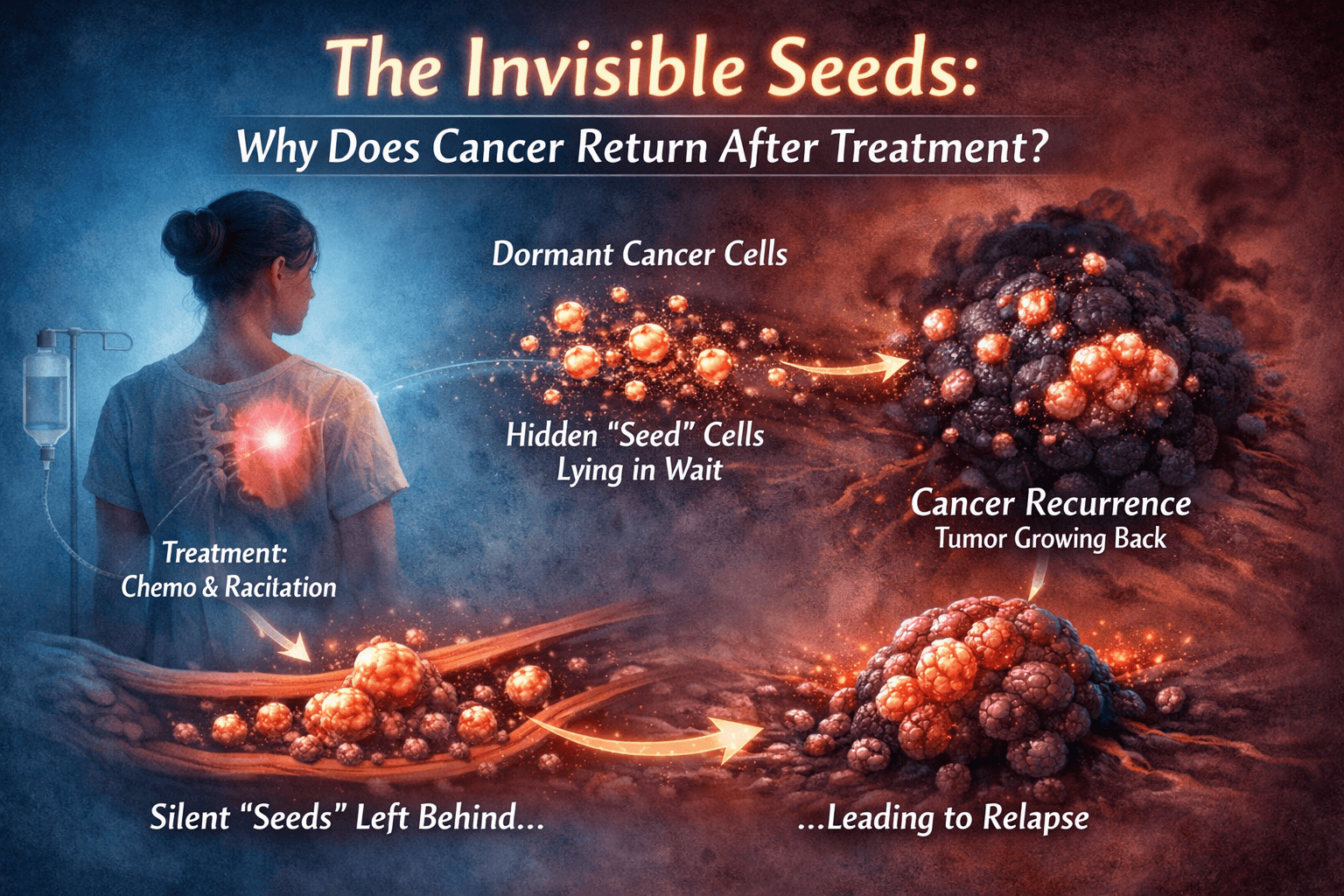
Completing cancer treatment is a victory, but it often comes with a lingering question: “If the tumor is gone, why can the cancer come back?”
Dr. Sandip Ganguly, Consultant Medical Oncologist in Kolkata, explains that the answer lies in the invisible, microscopic nature of the disease. It is not just about the tumor you can see; it is about the “invisible seeds” that may remain.
Why does cancer recur?
Cancer often returns because of micrometastasis. Even after a tumor is removed, microscopic cancer cells may still exist in the blood circulation pathways. Additionally, Cancer Stem Cells can hide in deep reservoirs like the bone marrow, evading initial treatment and potentially regrowing later.
1. It Is Not Just a Localized Disease
When cancer is diagnosed in organs like the breast, lung, or colon, we often assume the disease is limited to that specific spot. However, Dr. Ganguly explains that cancer is often systemic.
- Circulating Cells: Cancer cells can exist within the blood circulation pathways, a condition known as micrometastasis.
- Hidden Reservoirs: Beyond the blood, Cancer Stem Cells—the root source of the disease—can hide deep within the body, such as in the bone marrow, rather than staying in the affected organ.
Because these cells travel through the blood or hide in the marrow, they are not removed during the surgical excision of the primary tumor.
2. The Battle: Chemotherapy vs. Cell Volume
The primary purpose of chemotherapy is to hunt down and destroy these wandering micrometastases and hidden stem cells. However, the success of this treatment depends heavily on the stage of the disease:
- Early-Stage Cancer: The volume (number) of micrometastases or stem cells is usually very low. Chemotherapy can easily destroy this small number, preventing the disease from returning.
- Advanced-Stage Cancer (e.g., Stage 3): Patients generally have a much higher volume of micrometastases. Despite chemotherapy, the sheer quantity of these microscopic cells makes it harder to eliminate every single one. If even a few survive, the disease has a higher tendency to return later.
3. The Dandelion Analogy: A Simple Explanation
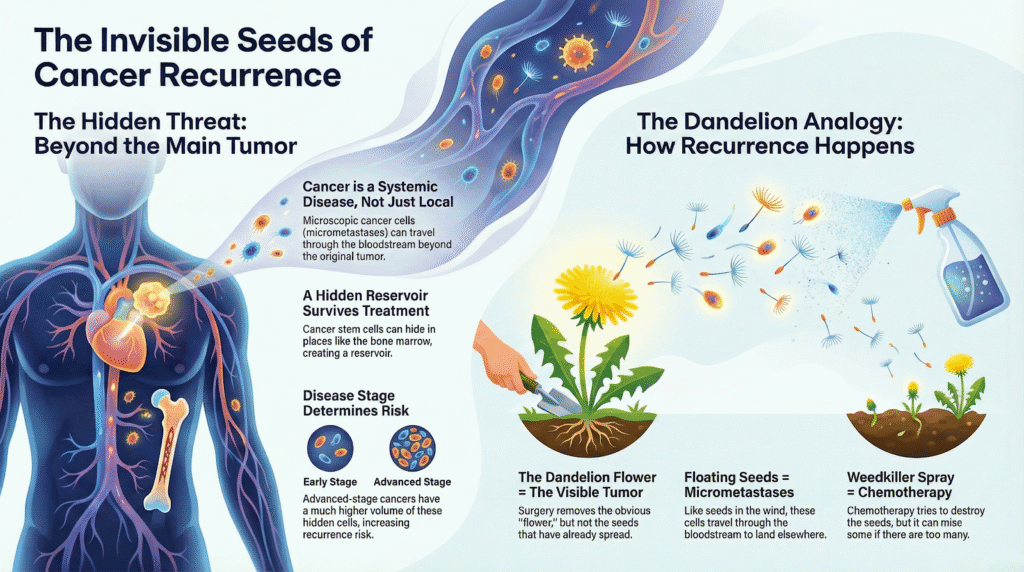
To understand why cancer recurrence happens, Dr. Ganguly offers a vivid analogy: The Dandelion Weed.
- The Tumor (The Flower): This is the visible yellow flower in your garden. Surgery cuts this off effectively.
- Micrometastases (The Seeds): These are the microscopic seeds floating in the wind (the bloodstream).
- Recurrence (The Regrowth): Even if you cut the flower, the floating seeds can land elsewhere and sprout new weeds.
How Treatment Works in this Analogy: Chemotherapy acts like a weedkiller spray designed to catch these floating seeds. However, if the weed was very large (advanced stage) and released millions of seeds, the spray might miss a few. This allows the weeds to eventually grow back, which is why regular monitoring is essential.
Takeaway: Cancer recurrence is driven by these “invisible seeds.” While early detection helps chemotherapy eliminate them effectively, understanding this mechanism highlights why doctors insist on regular follow-ups and scans even after you are “cancer-free.”
Disclaimer: This blog is based on general medical insights from Dr. Sandip Ganguly. Always consult your oncologist for personal medical advice.