

Head and neck cancer is one of the most serious and commonly diagnosed cancers in India, and 2026 has brought meaningful progress in how doctors treat it. The latest head and neck cancer treatment options now go far beyond surgery and traditional chemotherapy, with immunotherapy combinations, targeted biologics, and personalized treatment plans reshaping outcomes for patients. If you or a loved one is searching for head and neck cancer treatment near me, this guide will help you understand what options exist today and what questions to ask your oncologist.
What Every Patient Searching for the Best Head and Neck Cancer Care Should Remember
The treatment for head and neck cancer in 2026 is more personalized, less toxic, and more effective than at any earlier point in history. The key takeaways for patients are:
- HPV status, PD-L1 expression, and tumour location all guide which treatment protocol is best
- Immunotherapy combinations, particularly involving pembrolizumab and nivolumab, represent the most significant newly approved head and neck cancer treatment advances
- Early detection dramatically improves outcomes across all head and neck cancer subtypes
- Multidisciplinary care involving surgeons, radiation oncologists, and a qualified medical oncologist in Kolkata delivers the best results
- Quality of life is now a core part of treatment planning, not an afterthought
What Exactly Is Head and Neck Cancer and Who Does It Affect in India?
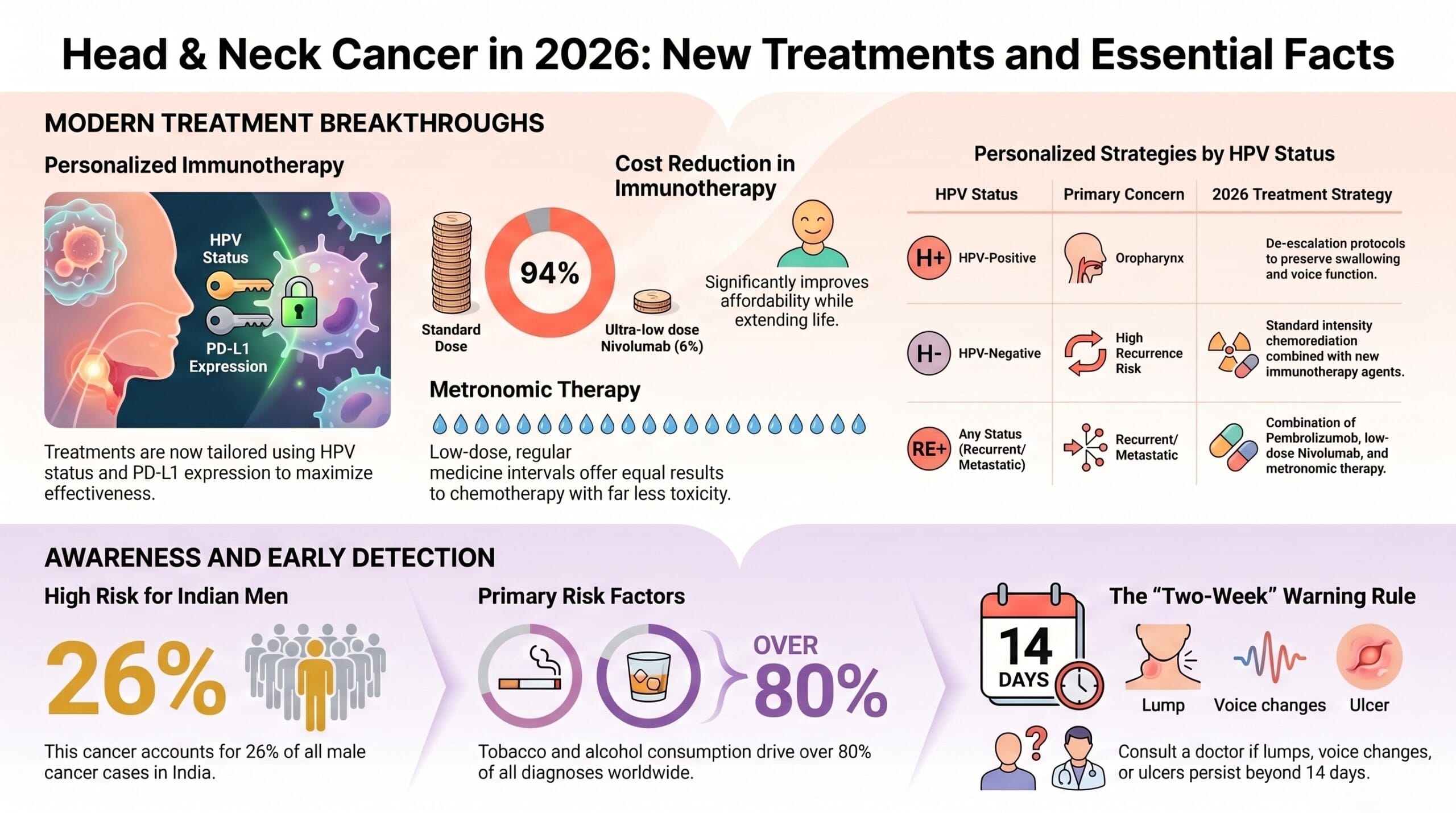
Head and neck cancer is a broad category of tumours that develop in the mouth, throat, larynx, salivary glands, nasal passages, and related structures. According to a large population-based analysis of 37 cancer registries across India, head and neck cancer accounts for approximately 26% of all cancer cases in males and 8% in females, with a risk of 1 in 33 for Indian men of developing the disease in their lifetime. This makes it one of the most pressing cancer concerns in the country. In India, head and neck cancers are the most common cancer among men and rank second overall, with tobacco and alcohol consumption driving over 80% of all diagnoses worldwide.
Patients seeking treatment should understand that the disease is highly treatable when detected at an early stage, and that 2026 treatment protocols now offer far more options than what was available even five years ago.
What Are the Standard Treatment Options for Head and Neck Cancer Today?
The standard treatment for head and neck cancer depends on the location of the tumour, its stage, and the patient’s overall health. The four main treatment categories are surgery, radiation therapy, chemotherapy, and systemic therapy. In most cases, these are used in combination rather than alone. The head and neck cancer treatment guidelines followed at leading oncology centres in 2026 emphasise a multidisciplinary team approach, where surgeons, radiation oncologists, and medical oncologists all contribute to the treatment plan.
Surgery remains a core component, particularly for resectable tumours in the oral cavity and larynx. Minimally invasive robotic and endoscopic techniques have reduced recovery time and minimised damage to surrounding healthy tissue.
Radiation therapy is often used after surgery to eliminate residual cancer cells or as the primary treatment for tumours in locations where surgery would compromise function, such as the larynx or throat.
Chemotherapy is commonly administered alongside radiation, with cisplatin remaining the most frequently used agent for locally advanced disease. Patients can read more about how chemotherapy works as part of a combined treatment approach.
Targeted therapy and immunotherapy are now central to the newly approved head and neck cancer treatment landscape, particularly for recurrent or metastatic cases. Cetuximab has shown benefit in patients with metastatic disease when it is given in combination with chemotherapy . Similarly Pembrolizumab alone or in combination with chemotherapy has shown marked improvement in survival
Metronomic therapy: It is a new form of administering anti cancer therapy. Here some medicines are given at low doses and at regular fixed intervals. Studies from Tata Cancer Hospital, Mumbai has shown that giving this metronomic therapy has shown equal results compared to injection chemotherapy with lesser toxicity and better quality of life.
What Are the Newest and Most Promising Head and Neck Cancer Treatments in 2026?
The most significant advances in the latest head and neck cancer treatment have come from immunotherapy and next-generation targeted agents. Patients looking for the best medical oncologist near me should ask specifically about these options when consulting their doctor.
Pembrolizumab combinations: Pembrolizumab (Keytruda), a PD-1 checkpoint inhibitor, continues to play a central role. The KEYNOTE-689 trial, which presented its surgical outcome data at the 2026 Multidisciplinary Head and Neck Cancers Symposium, studied the use of pembrolizumab both before and after surgery for resectable locally advanced head and neck squamous cell carcinoma. This represents a shift toward using immunotherapy at every stage of treatment, not just for advanced or metastatic disease.
Nivolumab combinations: NIVOSTOP trial has shown that when Nivolumab is given before initiating chemoradiation followed by maintenance therapy it reduces the chances of recurrences in patients with high risk head and neck cancer. This trial emphasizes the importance of adding immunotherapy to modulate the response to chemoradiation in these patients.
Amivantamab plus pembrolizumab: Subcutaneous amivantamab received breakthrough therapy designation from the FDA in early 2026 for recurrent or metastatic, HPV-unrelated head and neck squamous cell carcinoma, and combined use of amivantamab with pembrolizumab was found to be effective and safe in patients with PD-L1-positive HNSCC. This is among the most talked-about newly approved head and neck cancer treatment approaches of the year.
Ultra-low dose nivolumab: A study conducted in India found that an ultra-low dose of the immunotherapy drug nivolumab helped people with advanced head and neck cancer live longer, and because the dose is approximately 6% of what is typically used in Western countries, it is potentially far more affordable. This is particularly relevant for patients across India seeking effective treatment within manageable cost structures.
How Has the Treatment Approach for Advanced or Recurrent Head and Neck Cancer Changed in 2026?
For patients with stage IV or recurrent disease, the prognosis has historically been poor. However, 2026 has brought meaningful change to this picture. In stage IV head and neck cancer, the 5-year survival rate stands at approximately 36.9%, highlighting the importance of appropriate and timely decision-making in tumour management, and today’s progress in systemic therapies, immunotherapy, and precision oncology has greatly enhanced patient outcomes compared to the palliative-only approaches that were once the standard for metastatic disease.
The key shift has been from a one-size-fits-all protocol to a personalised treatment plan that accounts for the tumour’s molecular profile, HPV status, PD-L1 expression levels, and the patient’s functional goals. Patients who test positive for high PD-L1 expression, for instance, are likely to derive greater benefit from immunotherapy combinations. Those whose tumours are HPV-positive may be candidates for de-escalation trials, where treatment intensity is reduced to protect long-term quality of life without compromising survival.
Patients diagnosed at any stage should seek consultation with a qualified medical oncologist in Kolkata to understand which protocol fits their specific case.
What Role Does HPV Status Play in Choosing the Right Treatment for Head and Neck Cancer?
HPV status is now one of the most important factors in guiding head and neck cancer treatment guidelines. Oropharyngeal cancers (cancers of the back of the throat, tonsils, and base of the tongue) are increasingly associated with HPV infection and tend to respond better to treatment, resulting in improved survival rates compared to HPV-negative tumours. The treatment approach differs meaningfully based on this status:
| HPV Status | Tumour Location | Treatment Approach |
| HPV-positive | Oropharynx | May qualify for de-escalation protocols |
| HPV-negative | Oropharynx / Hypopharynx | Standard intensity chemoradiation, new immunotherapy agents |
| Any | Recurrent/Metastatic | Pembrolizumab, low dose nivolumab with oral metronomic therapy, Cetuximab |
| Any | Resectable locally advanced | Neoadjuvant immunotherapy + surgery + adjuvant therapy |
De-escalation trials such as the Quarterback studies at MD Anderson Cancer Centre are currently examining whether sequential induction chemotherapy followed by reduced-dose chemoradiation can safely maintain outcomes in HPV-positive oropharyngeal cancer. The goal is to preserve function, swallowing, and voice quality while still achieving tumour control.
What Are the Key Warning Signs That Should Prompt Someone to Seek Immediate Evaluation?
Early detection remains the single most effective way to improve outcomes in head and neck cancer. Patients should seek evaluation promptly if they notice any of the following symptoms persisting for more than two to three weeks:
- A persistent lump or swelling in the neck, jaw, or mouth
- Difficulty swallowing or pain while swallowing
- A sore or ulcer in the mouth that does not heal
- Hoarseness or a lasting change in the voice
- Persistent ear pain without an obvious cause
- Numbness in the mouth, lips, or face
- Unexplained weight loss
According to GLOBOCAN data, head and neck cancer globally affects nearly 1 million people every year, making early screening and awareness campaigns critical. Cancer screening and early detection services can identify high-risk individuals before symptoms become serious, particularly those with long histories of tobacco or alcohol use.
How Should a Patient in Kolkata Choose the Right Doctor for Head and Neck Cancer Treatment?
For patients searching for the best medical oncologist near me or head and neck cancer treatment near me in Kolkata, the right specialist makes an enormous difference. A good medical oncologist in Kolkata should be able to explain all available options, including newly approved head and neck cancer treatment protocols, and help patients understand the trade-offs between cure rates, functional outcomes, and quality of life.
Dr. Sandip Ganguly is a highly respected medical oncologist in Kolkata with over 14 years of experience in treating head and neck cancer as well as a wide range of other solid tumours. He currently serves as Consultant Medical Oncologist at Apollo Cancer Hospital, Kolkata, and previously spent eight years at Tata Medical Centre, Kolkata. His expertise spans chemotherapy, targeted therapy,metronomic therapy and immunotherapy, and he is well-versed in the evolving head and neck cancer treatment guidelines that shape modern oncology practice.
Patients can book an appointment by contacting his clinic at 99039 74739 or via email at dr.sandipganguly@gmail.com.
What Can Patients Expect During Treatment for Head and Neck Cancer?
The experience of treatment for head and neck cancer varies depending on the approach chosen, but all patients benefit from knowing what to anticipate. Side effects are real and manageable with proper support. Common challenges include:
During radiation therapy: Mouth soreness, difficulty swallowing, dry mouth, and taste changes are common. These are often managed with medications and nutritional support.
During chemotherapy: Nausea, fatigue, and immune suppression are typical. Dosing schedules are adjusted to balance effectiveness and tolerability.
During immunotherapy: Immune-related side effects such as skin rashes, thyroid hormonal changes, or joint pain can occur and require monitoring. These are generally manageable when caught early.
Functional recovery: Patients who undergo surgery near the larynx or pharynx may need speech therapy or swallowing rehabilitation. Modern robotic surgical techniques have reduced the extent of these functional impacts significantly.
Understanding why cancer can return after treatment is critical for head and neck cancer patients given the risk of locoregional recurrence, and sustained follow-up care is a non-negotiable part of the treatment plan.