

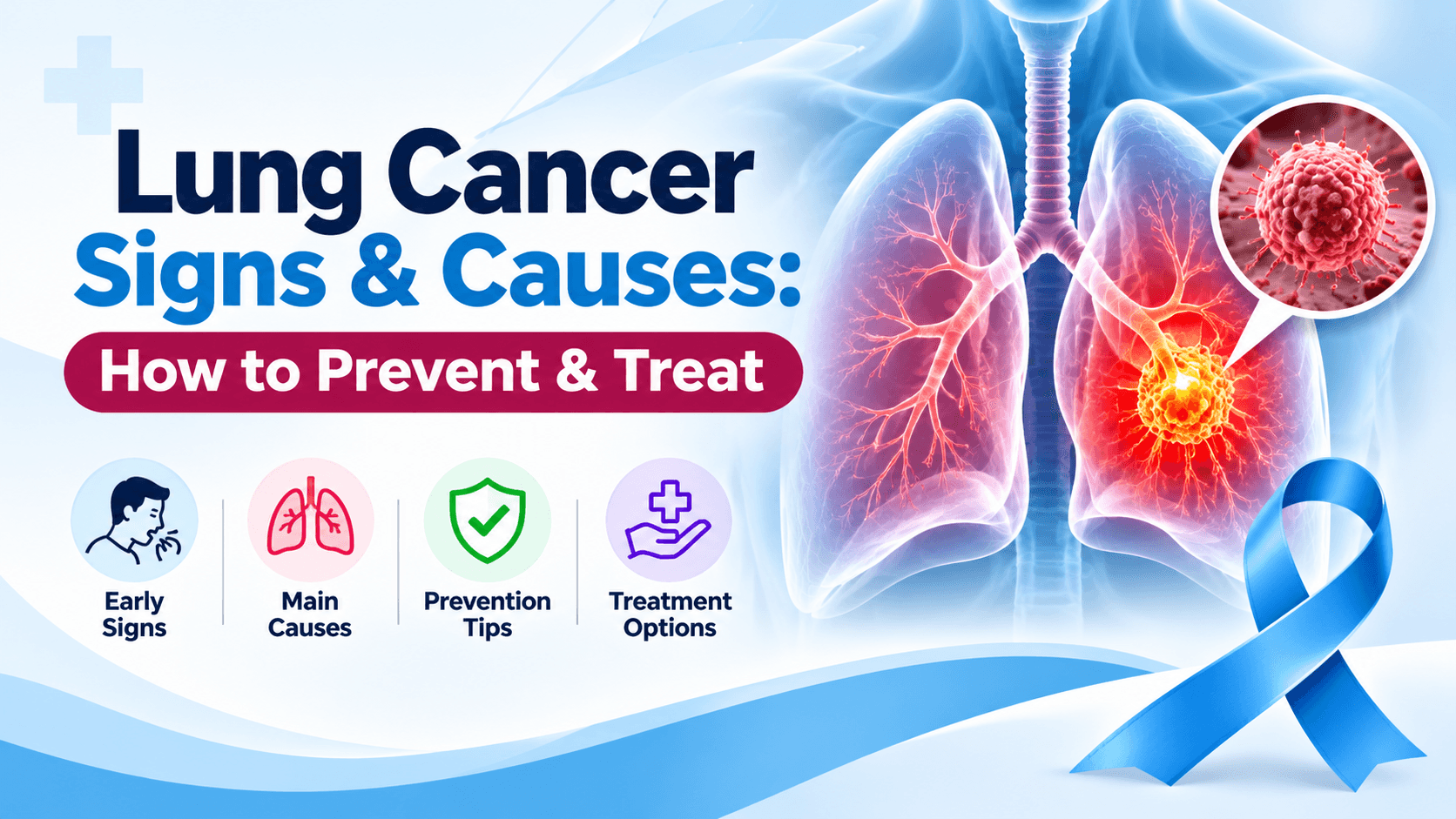
Lung cancer begins when cells in the lungs grow abnormally and form a tumor, most commonly a carcinoma, a cancer that starts in the cells lining the airways. Lung cancer is classified into two main types: non-small cell lung cancer (NSCLC) and small cell lung cancer (SCLC). NSCLC accounts for about 85 percent of lung cancers and includes adenocarcinoma, squamous cell carcinoma, and large cell carcinoma. The World Health Organization attributes 60 to 70 percent of cases to tobacco smoking, with air pollution and occupational exposure accounting for most of the remainder.
What are the early lung cancer signs?
Lung cancer causes no symptoms in its early stages. The most common early lung cancer signs are a persistent cough, breathlessness, chest pain, hoarseness, and unexplained weight loss. A cough or breathlessness lasting more than four weeks warrants medical evaluation.
Persistent cough
A cough that lasts more than four weeks, changes in character, or keeps getting worse is a common early sign of lung cancer. A tumor near a large central airway triggers a cough early because the tumor obstructs airflow.
Breathlessness and chest pain
Breathlessness during everyday activities such as walking or climbing stairs signals lung cancer and progresses until it occurs even at rest. Chest pain that worsens with deep breathing, coughing, or laughing is another warning sign.
Coughing up blood, hoarseness, and unexplained weight loss
Coughing up blood (hemoptysis), a recent change in voice or hoarseness, and unexplained weight loss are red-flag lung cancer signs in women and men alike. These red-flag signs require prompt medical attention rather than watchful waiting.
Symptoms by tumor location
A tumor near a large central airway triggers cough, wheezing, or repeated infections early because the tumor obstructs airflow. A tumor in the outer part of the lung produces few lung cancer signs in men or women until the tumor grows larger and presses on the chest wall, causing pain.
What are the main lung cancer causes?
Lung cancer develops when repeated damage to lung cells triggers genetic mutations that make the cells grow uncontrollably. Tobacco smoke is the leading cause, followed by air pollution, radon gas, secondhand smoke, and occupational exposure to asbestos and diesel exhaust. Several factors usually combine rather than acting alone.
Tobacco smoke delivers thousands of chemicals that damage lung tissue. Air pollution, radon gas, secondhand smoke, and occupational exposure to asbestos and diesel exhaust damage lung cells through the same pathway. Chronic lung disease such as chronic obstructive pulmonary disease (COPD) adds long-term inflammation that further injures the tissue.
The National Lung Screening Trial, led by Denise Aberle and colleagues at the National Cancer Institute and published in the New England Journal of Medicine in 2011, found that low-dose CT screening reduces lung cancer mortality. The World Health Organization and the National Cancer Institute identify tobacco use as the dominant cause, followed by air pollution and occupational exposure. There are also risk factors beyond smoking for lung cancer.
Can you get lung cancer if you never smoked?
Yes. Lung cancer develops in people who have never smoked, and the number of non-smoker cases is rising. Adenocarcinoma is the most common type in never-smokers. Air pollution, radon, secondhand smoke, and inherited genetic changes contribute to these cases.
Adenocarcinoma in non-smokers
Adenocarcinoma is the most common type of lung cancer in people who have never smoked. Targeted therapy becomes an option when molecular testing identifies EGFR or ALK mutations in the tumor.
How can you prevent lung cancer?
Lung cancer cannot be fully prevented, but specific actions reduce the risk. Quitting smoking, avoiding secondhand smoke, testing for radon, using protective equipment at work, limiting exposure to polluted air, and getting regular check-ups lower the chance of developing the disease.
A six-step prevention plan
The following are six actions that reduce lung cancer risk:
- Quit smoking. The risk of lung cancer starts to come down within five years of quitting, so stopping at any age reduces the risk.
- Avoid secondhand smoke. Stay away from tobacco smoke at home and at work.
- Test the home for radon. Radon is a naturally occurring radioactive gas that builds up indoors; reduce the level if it is high.
- Use protective equipment at work. Follow safety measures in jobs with exposure to asbestos, diesel exhaust, or other airborne hazards.
- Limit time in polluted air. On days of heavy outdoor air pollution, reduce strenuous outdoor activity and use air filtration indoors.
- Get regular check-ups. Discuss eligibility for low-dose CT screening with a doctor, especially with a smoking history.
See the cancer prevention services available in Kolkata for guidance on prevention, and discuss eligibility at the lung cancer screening page if you meet the criteria.
When should you see a doctor?
See a doctor when a cough, breathlessness, chest pain, or hoarseness lasts more than four weeks. Coughing up blood and severe breathing difficulty require immediate medical attention. A chest infection that keeps returning also warrants evaluation.
The four-week rule
A cough, breathlessness, chest pain, or hoarseness that lasts more than four weeks warrants a medical evaluation rather than waiting to see if the symptom clears on its own.
Red flags that need immediate attention
Coughing up blood and severe breathing difficulty require urgent medical care. A chest infection that keeps returning or does not clear is another reason to seek evaluation.
Acting early matters because delayed diagnosis is a major reason lung cancer is found at an advanced stage. The awareness campaign for early lung cancer detection explains why late diagnosis remains common in India, and scheduling a consultation with an oncologist in Kolkata can help you determine whether further evaluation is needed.
How is lung cancer treatment decided?
Lung cancer treatment in Kolkata depends on the cancer type, stage, molecular profile, and the patient’s overall health. Doctors stage the cancer using the American Joint Committee on Cancer (AJCC) TNM system. Molecular testing for biomarkers such as EGFR, ALK, ROS1, and PD-L1 determines whether targeted therapy applies.
How staging guides treatment
Doctors stage lung cancer using the AJCC TNM system, which classifies the tumor (T), nearby lymph nodes (N), and distant spread (M). The stage determines whether the goal is cure, long-term control, or symptom relief.
Molecular testing and targeted therapy
Molecular testing checks the tumor for biomarkers such as EGFR, ALK, ROS1, and PD-L1. Targeted therapy applies when a targetable mutation is present; otherwise immunotherapy or chemotherapy applies.
Treatment options across the journey
The following are four tiers of treatment that cover most lung cancer cases:
- First-line for early-stage disease. Surgery or radiation therapy is the standard approach when the cancer is localized. Often chemotherapy, immunotherapy and targeted therapy is given in early stage disease
- First-line for advanced disease. Chemotherapy, immunotherapy, or a combination is used when the cancer has spread or surgery is not possible.
- Second-line and alternatives. Targeted therapy applies when molecular testing finds an actionable mutation, and clinical trials offer newer options.
- Emerging approaches. Liquid biopsy, AI-assisted imaging, and newer immunotherapy agents are gaining adoption and expanding options for eligible patients.
Looking for the best oncologist in Kolkata for lung cancer? Dr. Sandip Ganguly is a cancer specialist in Kolkata with more than 14 years of cancer care experience, and a senior consultant medical oncologist at Apollo Cancer Hospital. Dr. Ganguly builds each lung cancer treatment plan around the cancer type, stage, molecular profile, and the patient’s overall health. To book a consultation or request a second opinion from a cancer specialist in Kolkata, contact our clinic.
What questions should you ask your oncologist?
Asking the right questions clarifies the diagnosis and treatment plan. Ask about the cancer type and stage, whether molecular testing was done, the goal of treatment, the side effects of each option, and eligibility for screening or a clinical trial.
The following are questions to ask the oncologist:
- What type and stage of lung cancer do I have, and what does that mean for my treatment options?
- Has molecular testing been done, and which biomarkers such as EGFR, ALK, ROS1, or PD-L1 were checked?
- What is the goal of my treatment: cure, long-term control, or symptom relief?
- What are the main side effects of each option, and how are they managed?
- Am I eligible for low-dose CT screening or a clinical trial?
Frequently Asked Questions
What are the different types of lung cancer?
Lung cancer is classified as non-small cell lung cancer (NSCLC) or small cell lung cancer (SCLC). NSCLC accounts for about 85 percent of cases and includes adenocarcinoma, squamous cell carcinoma, and large cell carcinoma. SCLC is less common and grows faster.
How is lung cancer diagnosed?
Lung cancer is diagnosed through imaging such as a chest X-ray or CT scan, where doctors check for specific lung cancer signs on ctscan. A biopsy then confirms the cancer and its type, while molecular testing on the tissue identifies biomarkers that guide treatment.
Can lung cancer be cured?
Lung cancer is curable in some people when found early and treated with surgery or radiation. For advanced disease, the goal is long-term control rather than cure.
What is the life expectancy for lung cancer?
Life expectancy depends on the cancer type, stage, and the person’s overall health and response to treatment. Survival statistics are group averages and do not predict an individual outcome.
How is lung cancer different from COPD or tuberculosis?
Lung cancer shares symptoms such as cough and breathlessness with COPD and tuberculosis, which delays diagnosis. A persistent or changing symptom is the reason to get imaging.
Is lung cancer treatment painful?
Treatment discomfort varies by the type of therapy, and most side effects are manageable. Pain and other symptoms are treated as part of care, and many patients continue daily activities during treatment.
How long does lung cancer treatment last?
Treatment length depends on the cancer type, stage, and the chosen approach. Surgery is a single course, while chemotherapy or immunotherapy runs for several months in scheduled cycles.
Does a blood test detect lung cancer?
While doctors look for lung cancer signs on blood work to evaluate overall health, a blood test alone does not diagnose lung cancer. Definitive diagnosis requires imaging and a tissue biopsy.
Comments are closed